miércoles, 27 de julio de 2016

Hillary Clinton, France, Olympics: Your Wednesday Briefing

Hillary Clinton

(Want to get this briefing by email? Here’s the sign-up.)

Good morning.

Here’s what you need to know:

• Democrats make history.

Hillary Clinton on Tuesday officially became the first woman to be nominated for president by a major party. Mrs. Clinton hailed the moment in an address from her home in New York, telling women at the convention, “This is really your night.” 

But some of her advisers say that overemphasizing the achievement could backfire — a video casting her as a worthy heir to the women’s rights movement was pulled from Tuesday’s convention lineup. In polls, Mrs. Clinton is showing enormous weakness with a group that represented nearly half of all voters in 2012: white voters, particularly men, without a college degree.

Bill Clinton delivered a deeply personal speech, talking about his wife’s life and career, while Mrs. Clinton’s aides try to prepare for his possible role as White House spouse. Here are our takeaways from Day 2, and what to watch for today.

• President Obama’s turn.

Mr. Obama’s address tonight will aim to bolster Mrs. Clinton’s standing with voters, but it will also represent the start of his farewell.

Without his unifying presence, or the focus on health care, Democrats are searching for the party’s next great project.

• Behind the leaked D.N.C. emails.

We’ve learned that the WikiLeaks founder, Julian Assange, said in an interview weeks ago that he had a trove of emails which he hoped would harm Mrs. Clinton’s chances of winning. He accused the former secretary of state of having been among those pushing to indict him after WikiLeaks released diplomatic cables.

Julian Assange

U.S. intelligence agencies are said to have “high confidence” that the Kremlin was behind the hacking of the D.N.C.’s emails.

• Religious solidarity in France.

President François Hollande is meeting today with the leaders of many faiths, after the Rev. Jacques Hamel, an 85-year-old Catholic priest, was killed as he celebrated Mass in his church in Normandy on Tuesday. The Islamic State group claimed responsibility for the killing.

makeshift memorial

The attack threatens to overshadow World Youth Day, one of the major events on the Catholic calendar.

• Mass killings as contagion?

A small number of people with strong personal grievances appear to be mining massacres for methods and potential targets to plan their own rampages.

We take a closer look at the human toll of these attacks in our profiles of the 247 victims who were killed in six countries during eight terrorist attacks across two weeks in March.

martes, 26 de julio de 2016

In D.N.C. Hack, Echoes of Russia’s New Approach to Power

hack, echoes

Of the questions raised by charges that Russia was involved in the release of hacked Democratic National Committee emails, at least one — why would Russia do such a thing? — can be answered with a little-noticed but influential 2013 Russian military journal article.

“The very rules of war have changed,” Gen. Valery V. Gerasimov, the chief of the general staff, wrote in the Military-Industrial Courier.

The Arab Spring, according to General Gerasimov, had shown that “nonmilitary means” had overtaken the "force of weapons in their effectiveness.” Deception and disinformation, not tanks and planes, were the new tools of power. And they would be used not in formally declared conflicts but within a vast gray between peace and war.

Those ideas would appear, the next year, in Russia’s formal military doctrine. It was the culmination of a yearslong strategic reorientation that has remade Russian power, in response to threats both real and imagined, into the sort of enterprise that could be plausibly accused of using cyberattacks to meddle in an American presidential election.

‘We are protecting our sovereignty’

Like so many military rethinks, what became known as the Gerasimov Doctrine began as an effort to solve a seemingly urgent problem.

Throughout the 2000s, popular uprisings in Eastern Europe and Central Asia overturned their pro-Kremlin leaders, replacing them with democratically elected governments more inclined to the West.

In Moscow, these “color revolutions,” as well as the subsequent Arab Spring, were seen as a wave of hostile American operations, engineered to topple Russia’s allies and weaken Russia itself.

Sergei Shoigu, the Russian defense minister, said in a 2014 speech that such uprisings were “used as an excuse to replace nationally oriented governments with regimes controlled from abroad.”

The Kremlin felt encircled and threatened by what it took to be a vast American conspiracy whose ultimate goal, it concluded, was the subjugation or outright destruction of the Russian state.

In December 2011, thousands gathered in Moscow to protest legislative elections that had been marred by accusations of fraud. The demonstrations didn’t come to much, but they engendered a fear among Russian leaders that they were next.

mobile missile


President Vladimir V. Putin, at a news conference in 2014, warned that the West was seeking to “defang” the Russian bear — to remove its nuclear weapons so as to gain access to its natural resources.

“Once they’ve taken out his claws and his fangs, then the bear is no longer necessary,” Mr. Putin said. “The issue is that we are protecting our sovereignty and our right to exist.”

Russian military planners, apparently obsessed with such fears, concluded that their best defense would be to go on the offense. Believing that the Americans were already conducting a clandestine war through intelligence operations, media disinformation, and deniable proxy forces, they set out to do the same.

The phrase “hybrid war” — a common label in the West for Russia’s actions — was first used by Russian analysts to describe the supposed American tactics they believed they were countering. They called their own strategy something different: “new generation war.”

Projecting power beyond Russia’s strength

Even before this doctrine became formalized, Russia had developed tools of coercion and subterfuge, providing a model for wider usage.

As Russian power has resurged under Mr. Putin, the country has often used asymmetrical methods to assert its interests, particularly in the former Soviet republics it still considers its “near abroad” and rightful zone of influence.

In 2007, amid tensions with the small Eastern European nation of Estonia, Russian media falsely reported that members of Estonia’s Russian minority were being drugged and tortured by police, contributing to riots that injured several people and killed one. The next day, cyberattacks, attributed to a pre-Kremlin Russian group, forced many of Estonia’s major institutions offline.

At no point, in the 2007 episode, did Russia commit an act of military aggression against its neighbor. Yet Estonian leaders say these actions were meant as a message: Even if their country had joined NATO and the European Union, Moscow was still the boss.

These sorts of tools allowed Russia to project power beyond its strength and, just as importantly, to assert its interests abroad despite Western military and political dominance.

To paraphrase Mark Galeotti, a New York University professor who studies Russia’s military, this is a country whose economy is smaller than Canada’s or South Korea’s, yet is seeking a great power role akin to China or the United States. Traditional methods won’t cut it.
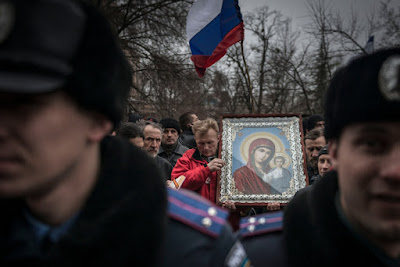
russia protesters


Information struggle and Maidan technology

Russia deployed its "new generation war” to startling effect in early 2014, when, amid Ukraine’s political crisis, it seized and subsequently annexed the Ukrainian region of Crimea.

While that action is most remembered for the “little green men” — unmarked Russian special forces who seized key locations in a clandestine invasion — there were subtler components as well.

Russian state news media flooded Crimea’s airwaves with false stories about neo-Nazis taking over Ukraine and systematically attacking ethnic Russians, who are a majority in Crimea. As a result, many Crimeans welcomed the unmarked Russian troops, believing they were being saved from possible ethnic cleansing.

Dmitry Adamsky, an Israeli analyst, wrote in a 2015 report that this “information struggle” is central to Russia’s new strategy.

This information war, he wrote, “comprises both technological and psychological components designed to manipulate the adversary’s picture of reality, misinform it and eventually interfere with the decision-making process of individuals, organizations, governments and societies.”

While this was especially visible in Crimea, Mr. Adamsky warned that it was also deployed in peacetime and against any target where Moscow seeks influence. It may be intended to pursue a “strategic goal,” such as the weakening of pro-American political parties in Europe, or to simply foment a degree of instability that weakens adversaries.

Mr. Adamsky described this as a form of “subversion” that “aims to deceive the victim, discredit the leadership, and disorient and demoralize the population and the armed forces.”

That sheds light on why Russia might want to release Democratic National Committee emails, whose greatest effect is creating a kerfuffle within Democratic politics. It’s not as if the resignation of the party chairwoman, Debbie Wasserman Schultz, was some strategic Russian ambition.

While some observers say Moscow sees a potential friend in Donald J. Trump, it would also be well within Russian strategy to stir up trouble just to stir up trouble. This is what Mr. Adamsky calls “managed stability-instability” — low-level confusion and disunity that Russia could perhaps one day exploit.

Russia has long seen itself as the victim of these very tactics, accusing Western governments of using vague “Maidan technology,” named for the square where Ukraine’s 2014 protests began, to create “managed chaos” in targeted countries. Embarrassing stories, such as the Russian doping scandal and the Panama Papers, are seen as American information warfare meant to weaken Moscow.

In this view, Kremlin leaders could see releasing internal Democratic emails as a tit-for-tat retaliation in the information struggle. Such a thing would make little sense in the Western conception of geopolitics. But as Mr. Adamsky wrote in his 2015 study, Americans have long tried to conceptualize Russian strategy within Western ways of thinking, when it is anything but.

China Tiger Attack Kills Woman at Drive-Through Animal Park


A woman was killed by a tiger over the weekend after jumping out of a car in a Beijing animal park to try to save her daughter from a tiger attack, local government officials said.

At least one tiger mauled the women on Saturday at Badaling Wildlife World in a section that allows people to drive their own vehicles through a Siberian tiger enclosure, the Yanqing County government said in a written statement.

Surveillance video that circulated widely online showed a woman exit a car, then walk to the other side of the vehicle, where she was attacked a few seconds later by a tiger. As the animal dragged her away, her husband and mother jumped out in an attempt to rescue her.

The woman left the car because of an argument with her husband, reported The Legal Evening News, based in Beijing. The Beijing News, also based in the Chinese capital, quoted a friend of the family who denied that the couple had been fighting.

The woman who was first attacked was badly injured, and her mother, who left the car in an effort to save her daughter, was killed, The Beijing News reported. The woman’s husband was uninjured, as was their child, who remained in the vehicle, the newspaper said.

The park, near a famous section of the Great Wall in a county north of central Beijing, has had serious safety problems before. In March, a park employee was killed by an elephant. A security guard who stepped out of a patrol vehicle was killed by a tiger in 2014.

In 2009, an 18-year-old man was killed by a tiger in the park after he scaled a fence with two friends to enter the animals’ enclosure. The men had apparently been trying to take a shortcut through the park after a hike along the Great Wall, reported Xinhua, a state-run news agency.

While the number of wild tigers in China has dropped to fewer than two dozen living in the far northeast, where they cross back and forth into Russia, thousands of tigers are raised in parks around the country. Visitors to parks in cities like Harbin can pay to feed them, sometimes with live animals. Critics say such breeding programs do little to help wild populations and are sometimes used as cover for the illegal trade in animal parts, like tiger pelts and wine made from their bones.


A deadly hostage-taking at a Catholic church in Normandy, in which a priest was killed and another person seriously wounded, was a terror attack committed in the name of ISIS, French President Francois Hollande has said.

Speaking to journalists in the northern French town of Saint-Etienne-du-Rouvray, where two men took five people hostage during morning Mass Tuesday, Hollande said the attack was a "cowardly assassination" carried out by "by two terrorists in the name of Daesh" -- another name for ISIS.
In the latest Islamist atrocity to roil France, an 84-year-old Catholic priest, the Rev. Jacques Hamel, was killed when two men stormed the church in the northern region of Normandy, Dominique Lebrun, the Archbishop of Rouen, said in a statement posted on the diocese website.

deadly church attack in france

Police and firemen arrive at the scene of the attack.
Besides the slain priest, two nuns and two churchgoers had been taken hostage, CNN French affiliate BFMTV reported.
One of the hostages was seriously wounded, and is "between life and death," French Interior Ministry spokesman Pierre-Henry Brandet told reporters.
The situation ended when the two attackers were shot dead by police, he said. "The two killers came out and they were neutralized," he said.

Hollande: ISIS 'has declared war on us'

The priest's killing comes on the back of a string of violent attacks across Europe in recent days, some claimed by the Sunni terror group ISIS, most notably an attack in the French city of Nice less than two weeks ago that left 84 dead.
France has been under a state of emergency since the Paris terror attacks in November last year.
Speaking to reporters, Hollande said: "Daesh has declared war on us. We have to win that war."
But urged the public to remain unified in the face of the threat.
"All people feel affected so we must have cohesion ... no one can divide us," he said. "Terrorists will not give up on anything until we stop them."
The Paris anti-terror prosecutor has taken over the investigation into the attack, France's Interior Ministry said in a statement.

Vatican condemns killing

The Vatican has condemned the attack, calling it "terrible news" on the back of a string of recent violent attacks in Europe. It said the Pope had been informed of the attack and shared the pain and horror in response to the "absurd violence."
The statement said the violence was particularly horrific as it had taken place in a church, "a sacred place where the love of God is announced."
Lebrun said in a statement that the "Catholic church cannot take up any other weapons but prayer and brotherhood among men."
He called on the faithful "to lower their arms before violence and to become an apostle of a civilization of love."
Other religious leaders were quick to condemn the violence, with the Archbishop of Canterbury, Justin Welby, tweeting: "Evil attacks the weakest, denies truth (and) love, is defeated through Jesus Christ. Pray for France, for victims, for their communities."

viernes, 22 de julio de 2016

Munich shooting: Police operation underway, report says several killed at mall


A police operation is underway after gunfire erupted Friday at a shopping center in Munich, Germany. German media are reporting six people were killed in the shooting spree. Authorities shut down public transportation and warned people to stay home or seek protection.

Here's what we know so far:
  • At least one shooter remains on the loose after a shooting inside a McDonald's across from the Olympia shopping mall, police spokeswoman Claudia Küntzel said. "There could be several dead, and one or even several shooters are on the loose," Küntzel said. The shooting at the McDonald's happened around 5:50 p.m. (11:50 a.m. ET), she said. It's unclear whether shootings have occurred at other locations, and whether the gunfire has stopped.
  • Gunfire also broke out inside the mall, witnesses said.
  • On Facebook, police said gunfire was reported in several locations, and that witnesses report seeing three people with firearms.
  • "At the moment, we have not been able to arrest any perpetrators. The manhunt is underway at high speed," police said. "Because of the unclear situation we ask all people in the city area to stay at home or to look for protection in any nearby building. The operation of public transportation service has been stopped."
  • Lauraetta Januze told CNN her son was in a bathroom with a shooter at the McDonald's. "That's where he loaded his weapon," she said. "Boom, boom, boom, I heard, and then I saw all the injured. I was back to back with him, I was in the bathroom with my kid, and I only saw him shoot directly into the faces of children."
  • Lynn Stein, who said she works at the Jack Wolfskin store in the mall, said she heard six of seven shots inside the mall. "People were very confused, and they were running and they were screaming," she said. She said she saw someone lying on the floor of a store who appeared to be either dead or injured. "There's a woman over them, crying."
  • Outside the mall, she said, police ran with large guns and told people to clear the area.
  • Thamina Stoll told CNN she was with her grandmother, who lives about three minutes away from the mall: "There were like 50 people running towards our house to seek shelter, and there was a helicopter circling above us for about 20 minutes and sirens. And there's still people walking on the streets, they're confused, and nobody knows what's really going on."
munich

  • The shooting comes as recent terror attacks have put Europe on high alert. A truck plowed into a crowd of Bastille Day revelers in Nice, France, last week, killing more than 80 people. This week, a teenager who said he was inspired by ISIS stabbed passengers on a German train before police shot him dead.
CNN's Dugald McConnell, Claudia Otto, Bharati Naik, Vasco Cotovio, Laura Perez Maestro and Donie O'Sullivan contributed to this report.


Queens Crusader Turned the Tide for a Crumbling Park and Its Sea Wall

Queens Crusader Turned the Tide for a Crumbling Park and Its Sea Wall

Into her 80s, Elizabeth McQueen patrolled Queensbridge Park in Long Island City, Queens, wheeling her walker, a grandson or a great-grandchild at her side, eyes sweeping the walks and lawn. “If someone was barbecuing, she made sure they had garbage bags,” her grandson, Desmen Williams, said. “She had a bin of supplies. A rake if you needed to rake up. She made sure the fire barrels were out there, so you put coals in the barrel when you were done.”

The park is on the eastern bank of the East River, across from the Upper East Side of Manhattan, and Mrs. McQueen lived in the Queensbridge Houses, home to about 7,000 people, the largest public housing development in the country.

“We used to take the kids down to the park,” Dolores Chauncey, her friend and neighbor, said. “She’d say, ‘We’re on one side of the river and the millionaires were on the other, but we have the better view. We can lay in the park and watch the boats go by, and wait for the stars and moon to come out.’ And we did.”

Mrs. Chauncey and Mrs. McQueen met about 40 years ago, another age in New York. The children splashed in a baby pool in the summertime, fished from the rocks when they got older, picnicked at all ages. But along the riverfront, the sea wall, built on a foundation of loose stone called riprap, was falling apart. To keep people away from the hazard, the parks department fenced off the area, including an esplanade. Decay marched on: One of two playgrounds was turned into a parking lot for people working on the Queensboro Bridge. The park house, with its concession stand and changing rooms for the wading pool, was left to the elements. And the pool was drained and filled in, visible only in the mind’s eye.

“It broke her heart that children were playing in a park that they could literally see crumbling into the river,” Councilman Jimmy Van Bramer, a Democrat who represents the area, said. “It wasn’t just about the park, it was about justice. Nowhere in Manhattan would this be allowed to happen.”

Mrs. McQueen reared back and leaned against the universe. In between working as a technician at Polaroid and looking after her grandson, she became a world-class nudge. “She had no problem calling any elected official at any level,” said Chris Hanway, the executive director of the Jacob Riis Neighborhood Settlement House, where Mrs. McQueen served on the board.


And she leaned on nonelected officials, too. “This was a real problem site, and she in the most gracious possible way kept the pressure on,” said Adrian Benepe, the commissioner of the parks department from 2002 to 2012, who noted that the park was not in a fashionable neighborhood likely to attract private funds. She was installed as the park’s warden, a titled volunteer, in recognition of her stature.

With friends and allies in the community and government, she organized Dancing Under the Stars nights, Super Soaker days for water-gun battles, puppet theaters, concerts and more. Battered as it was, the park remained alive and lively.

That was the daily business. In the long term, she wanted New York City to rebuild the sea wall and restore access to the walkway along the water. At least four agencies had dominion over some piece of the park, and yet others had a say in granting permits. For the $7 million cost, Mrs. McQueen chased down elected officials, including Democrats like Mr. Van Bramer; Helen M. Marshall, then the borough president; Representative Carolyn B. Maloney; and Assemblywoman Catherine T. Nolan, as well as the mayor at the time, Michael R. Bloomberg, a Republican turned independent.

About half — $3.65 million — was secured by Mr. Van Bramer through the City Council. “When the grant came in for the sea wall, she came into my house and said, ‘We got it!’” her grandson said. “If she could have done back flips, she would have.”

The esplanade reopened in summer 2014. She was not done. A new park house was needed. “She was right,” Mr. Van Bramer said.

Work will begin in the fall. Mrs. McQueen died in February at age 83.

On Friday, the city, urged on by Mr. Van Bramer, will declare the esplanade along the river to be Elizabeth McQueen Way. It runs atop the rebuilt sea wall, across from Manhattan towers named for corporations and real estate developers, a place where anyone who loves river breezes and moonlit nights can stroll.

“My grandmother did things a lot of people wouldn’t do because they didn’t think it was their job,” Mr. Williams said. “She’s gone. But she’s still winning.”

Verizon Is Said to Be Near a Deal to Acquire Yahoo

Verizon Is Said to Be Near a Deal to Acquire Yahoo

The end of Yahoo as an independent company may be near, and Verizon — long considered the leading contender to buy the aging web pioneer — is the most likely acquirer.

The two companies are in advanced talks over a takeover of Yahoo that could be worth close to $5 billion, a person briefed on the matter said on Friday.

Any transaction would be for Yahoo’s core internet business, although it is unclear whether a deal would also include other assets like real estate or patents.

Both companies are hoping to announce a deal as early as next week, this person said. Verizon is scheduled to report earnings on Tuesday.

Still, no final deal has been reached and the talks could still falter, the person cautioned. One of the other finalists could also re-emerge with a higher bid.

A spokesman for Verizon declined to comment, while a Yahoo spokeswoman said the company would not comment “until we have a definitive agreement to announce” because it wanted to maintain “the integrity of the process.” The state of discussions between Yahoo and Verizon was reported earlier by Bloomberg.

When Yahoo finally began exploring a sale of its core business — a sprawling collection of properties including its sports and news sites, email and the social network Tumblr — Verizon was considered the front-runner by analysts and investors. The telecommunications behemoth already owned AOL, another onetime internet darling that had fallen far from its peak.

Bankers for Yahoo cast a wide net for the auction, and a number of potential suitors emerged. The field winnowed down to a handful of bidders, which included AT&T, private equity firms like TPG Capital, and the Quicken Loans co-founder Dan Gilbert, with the backing of Warren E. Buffett company, Berkshire Hathaway.


But people involved in the process long believed that Verizon, with its enormous cash pile and its ability to wring out efficiencies by merging Yahoo with AOL, was the most likely winner.

Brian Wieser, an analyst with Pivotal Research, said that combining AOL with Yahoo would create a stronger No. 3 digital platform for online advertising, after Google and Facebook.

“This is a 1 plus 1 equals 2½,” he said.

Verizon, which had $132 billion in revenue last year, has been trying to build up its digital content portfolio, particularly in mobile and video, to serve customers of its wireless phone, cable TV and internet businesses. Last year, it bought AOL for $4.4 billion, acquiring not just its content sites like the Huffington Post and TechCrunch, but also the advertising technology used to target online ads to internet users.

Yahoo would bring in a huge amount of additional news, sports and finance content — and the one billion people a month who visit Yahoo services — and would offer Verizon another set of sophisticated ad technologies.

Yahoo’s BrightRoll division in particular is a leader in delivering automated, real-time advertising, and could be merged with AOL’s ad technology to deliver more appealing options to marketers, particularly in video.